

|
|
|
|
|
|
|
 |
|
|
 |
|
|
|
 |
|
|
 |
|
|
|
 |
|
|
|
 |
|
|
|
Course contentsReal Analysis is one of the central courses in the advanced education of mathematics students. The course is centred on abstract integration theory and measure spaces. The discussion of spaces of integrable functions will lead to a discussion of Hilbert and Banach spaces. Some of the central results of Functional Analysis, e.g., the Hahn-Banach theorem and the open mapping theorem will be proven. Due to the central role of integration in applied sciences, this course should also attract ambitious physics and engineering undergraduate and graduate students.
| |||||||||||||||||||||||||||||||||||||||||||||||||||||||||||||||||||||||||||||||||||||||||||||||||||||||||||||||||||||||||||||||||||||||||||||||||||||||||||||||||||||||||||||||||||||||||||||||||||||||||||||||||||||||||||||||||||||||||||||||||||||||||||||||||||||||||||||||||||||||||||||||||||||||||||||||||||||||||||||||||||||||||||||||||||||||||||||||||||||||||||||||||||||||||||||||||||||||||||||
| Short Name: | CompAnalysis | |
| Type: | Lecture | |
| Semester: | 2 | |
| Credit Points: | 7.5 | |
| Prerequisites: | None | |
| Corequisites: | None | |
| Tutorial: | No |
Complex Analysis builds on the material taught in the undergraduate Complex Variables course. After a quick review of the most important results and concepts, some more advanced topics are covered. Possible subjects are Riemann Surfaces, Elliptic Functions and Modular Forms, Complex Dynamics, Geometric Complex Analysis, or Several Complex Variables. Which subjects are chosen will depend on the instructor and on the students' interests. This course may also provide an introduction to a specific area of research, leading to possible PhD thesis projects.
| Short Name: | FunctAnalysis | |
| Type: | Lecture | |
| Semester: | 2 | |
| Credit Points: | 7.5 | |
| Prerequisites: | None | |
| Corequisites: | None | |
| Tutorial: | No |
This course assumes basic knowledge of measure and integration theory, and of classical Banach and Hilbert spaces of measurable functions. Functional Analysis focuses on the description, analysis, and representation of linear functionals and operators defined on general topological vector spaces, most prominently on abstract Banach and Hilbert spaces.
Even though abstract in nature, the tools of Functional Analysis play a central role in applied mathematics, e.g., in partial differential equations. To illustrate this strength of Functional Analysis is one of the goals of this course.
| Short Name: | Algebra | |
| Type: | Lecture | |
| Semester: | 1 | |
| Credit Points: | 7.5 | |
| Prerequisites: | None | |
| Corequisites: | None | |
| Tutorial: | No |
Advanced topics from algebra, including groups, rings, ideals, fields, and modules, continuing the course Introductory Algebra (100 321).
| Short Name: | AdvAlg | |
| Type: | Lecture | |
| Semester: | 2 | |
| Credit Points: | 7.5 | |
| Prerequisites: | None | |
| Corequisites: | None | |
| Tutorial: | No |
This course develops more advanced topics in algebra beyond those from the Algebra course (100 421), including commutative and non-commutative algebra (and their relations to algebraic geometry), categories and homological algebra, and representation theory.
| Short Name: | NumberTheory | |
| Type: | Lecture | |
| Semester: | 3 | |
| Credit Points: | 7.5 | |
| Prerequisites: | None | |
| Corequisites: | None | |
| Tutorial: | No |
This course is mainly an introduction to algebraic number theory, but it also covers some analytic number theory, most notably the Dedekind zeta function and the analytic class number formula. Topics include algebraic number fields and their rings of integers, ideal theory in Dedekind rings, localization, p-adic numbers and fields, ideal class group and unit group, finiteness of the class number, Dirichlet unit theorem, Dedekind zeta function, analytic class number formula, perhaps Dirichlet L-series and a proof of Dirichlet's theorem on primes in arithmetic progressions, Artin reciprocity with the main results (no proofs) of class field theory.
| Short Name: | AlgebrTopology | |
| Type: | Lecture | |
| Semester: | 2 | |
| Credit Points: | 7.5 | |
| Prerequisites: | None | |
| Corequisites: | None | |
| Tutorial: | No |
This course is mostly concerned with the comprehensive treatment of the fundamental ideas of singular homology/cohomology theory and duality. The knowledge of fundamental concepts of algebra as well as of general topology is assumed (at a level of Introductory Topology and Introductory Algebra).
The first part studies the definition of homology and the properties that lead to the axiomatic characterization of homology theory. Then further algebraic concepts such as cohomology and the multiplicative structure in cohomology are introduced. In the last section the duality between homology and cohomology of manifolds is studied and few basic elements of obstruction theory are discussed.
The graduate algebraic topology course gives a solid introduction to fundamental ideas and results that are used nowadays in most areas of pure mathematics and theoretical physics.
| Short Name: | DiffGeom | |
| Type: | Lecture | |
| Semester: | 3 | |
| Credit Points: | 7.5 | |
| Prerequisites: | None | |
| Corequisites: | None | |
| Tutorial: | No |
Differential geometry is the study of differentiable manifolds. Assuming basic concepts from 100 311 (Integration and Manifolds) and 100 351 (Introductory Geometry), such as manifolds, differential forms, and Stokes' theorem, the focus in this course is on Riemannian geometry: the study of curved spaces which is at the heart of much current mathematics as well as mathematical physics (for example, General Relativity).
| Short Name: | LieGroups | |
| Type: | Lecture | |
| Semester: | 2 | |
| Credit Points: | 7.5 | |
| Prerequisites: | None | |
| Corequisites: | None | |
| Tutorial: | No |
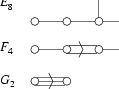
A Lie group is a group with a differentiable structure, the tangent space at the identity element of a Lie group is its Lie algebra. Lie groups and Lie algebras are indispensable in many areas of mathematics and physics. As a mathematical subject on its own, Lie theory has led to many beautiful results, such as the famous classification of semisimple Lie algebras. In physics, Lie groups and their representations are essential to the theory of elementary particles and its current developments. Due to the close correspondence of physical phenomena and abstract mathematical structures, the theory of Lie groups has become a showcase of mathematical physics.
The course presents fundamental concepts, methods and results of Lie theory and representation theory. It covers the relation between Lie groups and Lie algebras, structure theory of Lie algebras, classification of semisimple Lie algebras, finite-dimensional representations of Lie algebras, and tensor representations and their irreducible decompositions.
A solid background in multivariable real analysis and linear algebra is presumed. Familiarity with some basic algebra and group theory will also be helpful. No prior knowledge of differential geometry is necessary.
| Short Name: | AlgGeometry | |
| Type: | Lecture | |
| Semester: | 2 | |
| Credit Points: | 7.5 | |
| Prerequisites: | None | |
| Corequisites: | None | |
| Tutorial: | No |
Algebraic geometry is the study of geometry using algebraic tools: the geometric objects are the common roots of a set of polynomials in several variables. Many geometric properties can be studied in terms of algebraic properties of these polynomials, using the powerful machinery of algebra to study geometry.
Basic concepts from 100 421 (Algebra) and 100 321 (Introductory Algebra) are used in this course. Among the studied subjects are affine and projetive varieties, schemes, curves, and cohomology.
| Short Name: | DynSystems | |
| Type: | Lecture | |
| Semester: | 3 | |
| Credit Points: | 7.5 | |
| Prerequisites: | None | |
| Corequisites: | None | |
| Tutorial: | No |
Based on the undergraduate ODE/Dynamical Systems course, this course goes more deeply into the theory of discrete and continuous dynamical systems. Possible topics include bifurcation theory, stable and unstable manifolds, KAM theory, or the shadowing lemma. This course may also provide an introduction to a specific area of research, leading to possible PhD thesis projects.
| Short Name: | ApplAnalysis | |
| Type: | Lecture | |
| Semester: | 1 | |
| Credit Points: | 7.5 | |
| Prerequisites: | None | |
| Corequisites: | None | |
| Tutorial: | No |
The course Applied Analysis introduces a variety of analytical tools and methods which are used to model and analyse physical phenomena. Topics include: Fourier transformations, partial and ordinary differential equations, operator theory, asymptotics (WKB, stationary phase, etc.), wavelets and applications.
Even though this courses covers the fundamentals of each of the subjects above, the emphasis will depend on the instructor. Students of applied mathematics or applied sciences are encouraged to participate in this course more than once.
| Short Name: | NumAnalysis | |
| Type: | Lecture | |
| Semester: | 1 | |
| Credit Points: | 7.5 | |
| Prerequisites: | None | |
| Corequisites: | None | |
| Tutorial: | No |
This class is offered in two variants in alternating years. The first is focused on numerical linear algebra and optimization, the second is focused on differential boundary value problems and partial differential equations.
Specialized topics, often related to faculty research areas, are taught in the form of reading courses. Offers depend on student and faculty interests.
| Short Name: | MathColloquium | |
| Type: | Seminar | |
| Semester: | All | |
| Credit Points: | None | |
| Prerequisites: | None | |
| Corequisites: | None | |
| Tutorial: | No |
The weekly mathematics colloquium features talks by international scientists for the entire mathematical community, broadening horizons and encouraging formal or informal interactions.
| Short Name: | GradResearchSem | |
| Type: | Seminar | |
| Semester: | 1/2 | |
| Credit Points: | 7.5 | |
| Prerequisites: | None | |
| Corequisites: | None | |
| Tutorial: | No |
This course is intended for beginning graduate students to help them identify interesting areas of research and possible thesis subjects and advisors. It consists of lectures mainly by professors, but also by other faculty, about current areas of research in mathemaical sciences, with particular emphasis on research areas of Jacobs faculty. Students get involved in discussions of all the areas of research; during the course of the semester, they choose at least three topics which they investigate further and which they elaborate into a research report. At the end of the semester, every student presents at least one of these reports. Participation is also open for advanced undergraduates looking for topics for their undergraduate theses, the results of which are presented as well.
In addition, there are regular research seminars run by the
faculty of the graduate program on advanced subjects and/or on
topics of current research interests.
Last updated 2008-05-30, 14:29 by Iulian
Ilies. © Jacobs University Bremen. All rights reserved.
